part 2 of My Day in the Other Land
152 Lightbound all around and in the interstices of my soul.
eyes "selflessly empathetic, friendly My heart stood still, and resumed beating a moment later, stronger than ever." the Good Observer a form of looking and listening yawning as only newborns yawn
155 "No one had ever called me his friend that way. " "and eventually he became my sweetheart" -sister
157 "yonder shore (you read that right, 'yonder')" "flickering and fluttering on the keyboard of the waves"
5:16 pm finished My Day in the Other Land: A Tale of Demons was he imagining his own death? what death might be like if he had been the teller of it as a tale, a gathering of tales? gentle and lovely story at the lake of being called away from being possessed by demons by a friend, The Observer
reviewers didn't know what to say ----
from Library Journal 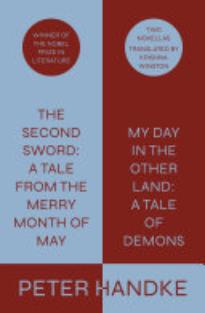
The Second Sword: Two Novellas
Farrar. Feb. 2024. 192p. tr. from German by Krishna Winston.
ISBN 9780374601447. $27. F COPY ISBN
Nobel Prize winner Handke (
The Fruit Thief) offers two novellas here. In the first, the narrator arrives home after several weeks of travel but leaves shortly after to avenge an insult made to his mother years earlier. What follows is a meandering and idiosyncratic daylong journey through the outskirts of Paris. The narrator encounters neighbors, shares bottles of wine with strangers, and engages children in staring matches, all the while becoming more and more intent on vengeance. In the second novella the narrator, a fruit farmer, has a psychotic breakdown, abandons his farm, and lives in a tent in a cemetery outside of town. His sister keeps an eye on him, and the townspeople view him with equanimity. When he recovers, he travels to a war-torn land across the lake. Mythological and religious imagery abound. Both stories are presented as interior monologues and have a hallucinogenic quality. The unpleasant personalities of the narrators may require persistence on the part of readers. Handke describes grim times but still manages to end on an encouraging note.
VERDICT The most recent work by a writer who’s celebrated, influential, and controversial in Europe.
and in Kirkus Reviews Dec 15, 2023 this does clarify a few details I didn't get or forgot about
Whereas in his nonfiction Handke can be polemical and strident, in his fiction he is rather more subtle—at least to a point. This brace of novellas is no exception. In the first, he opens with a never quite fully defined man who addresses himself in the mirror, saying, “So this is the face of an avenger!” He’s not a superhero, but instead a man who roams the streets of his adopted Paris in search of a journalist who’s landed a roundabout insult upon him by suggesting that his mother once rejoiced at the Anschluss by which Nazi Germany absorbed Austria into the Reich, “which made her a supporter, a Party member.” Not so subtle among the narrator’s wanderings are the encouragements he receives from an Arab shopkeeper: “‘Kill! With a sword. Mah al-saif. Off with his head!’ He didn’t ask for details; in his eyes, insulting a mother deserved nothing less than death.” One wonders, too, at Handke’s characterization of an African cook: “Back to Africa? Didn’t they need magicians there who practiced a different kind of juju, magicians like him?” Questionable racial asides notwithstanding, Handke’s protagonist is all talk and no action: The metaphorical sword he carries is one that merely carves the offender from memory. In the second novella, as if a German-language rejoinder to Juan Rulfo’s novel Pedro Páramo, an orchard keeper endures a period of madness profound enough to scare the neighbors: “…now and then there was something distinctly odd, uncanny, even sinister about me.” After pondering his demons at considerable length, he makes his way across a lake that divides his country from the next, only to find it apparently devoid of people—a commentary, one might suppose, on the recent pandemic. Improbably, in the ruins, he finds something approaching happiness, even if he still terrifies even his own children.
Enigmatic and sometimes troubling, and so trademark Handke.----not very favorable considerations, but then they've got the official narrative on Handke so they don't need anything else
---dissertation idea---the works writers do when they know their lives are almost over
157 what Goethe called oceanic stillness ancient Greek word for calm, tranquillity "galênê"
those reviews so worthless
after reading all of his novels I can see his motifs and obsessions limned in these novellas more faintly, more gently, softened with age and silence, if not masterpieces then perfect stones washed in rains and streams and rivers in a lifetime of contemplation and wonder

No comments:
Post a Comment